
Engineering brief
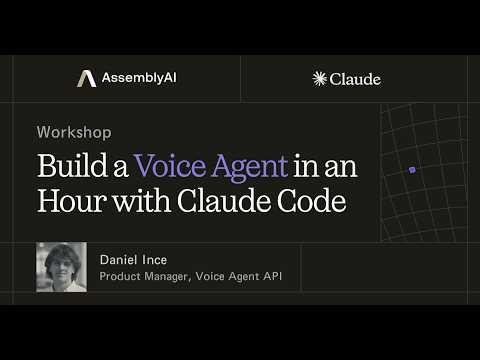
Build a Voice Agent in an Hour with Claude Code | AssemblyAI Workshop
The Brief
AssemblyAI’s Voice Agent API enables fast DIY voice agents; infra is solved, operations and tool design remain hard.
Decision relevance
Read this for workflow impact, implementation trade-offs, and the claims that need technical scrutiny before they reach team planning.
Summary
What changed: AssemblyAI now offers a vertically integrated Voice Agent API (STT+LLM+TTS) over WebSockets, designed to plug directly into your app and UI. In the workshop, Claude Code scaffolds a Python backend (token issuance) and a browser client that streams audio, shows transcripts, and handles tool calls—demonstrating that infra setup is no longer the main blocker.
Why it matters: Teams can bypass LiveKit/Pipecat orchestration and vendor-hosted “black box” agents, building bespoke experiences with their own UI and business tools (Calendly, databases, CRMs). The API’s simplicity shifts effort to conversation design, tool orchestration, latency policy, and monitoring—where outcomes are actually determined.
Tradeoffs: This is POC-friendly, not production-ready out of the box. Data retention is currently off (session history is “coming soon”); telephony/SIP is early-access; TTS is only available via the voice agent, not standalone; non-English/dialect voices are limited. Pricing claims were vague, and real enterprise needs (BAA, compliance, audit) require direct contact.
Operational consequences: Tool calling remains the brittle point. The recommended “progressive tool reveal” pattern (check first, then enable booking) and minimizing tools improves accuracy and reduces hallucinations. Latency tuning is a governance decision: lowering min/max silence reduces wait time but increases interruption risk; enable AEC if not using headphones. Use real call transcripts to ground prompts.
What teams should watch: Instrumentation, post-call scoring, and QA are not built-in; you’ll likely use their LLM Gateway or your own analytics for summaries and scoring. Plan for concurrency limits, cost controls, failure fallbacks, PII handling, and telephony integration timelines. Overreliance on agent-generated scaffolds can mask hidden complexity—own the code and tests.
Why It Matters
You can prototype domain-specific voice agents fast; the hard work moves to tool design, latency policy, monitoring, and governance.
Editorial analysis
Key claims
- Great for POCs and custom UIs; production needs ops, guardrails, and telephony plans.
Practical use cases
- Use this as input for tooling evaluation, workflow planning, and technical due diligence.
Risks / caveats
- “Build in an hour” as production reality; unclear pricing bravado.
Who should care
- Engineering managers, tech leads, and CTOs evaluating AI or developer tooling decisions.
Related topics
Bottom Line
Great for POCs and custom UIs; production needs ops, guardrails, and telephony plans.
Watch
This video is blocked due to your privacy settings. To watch this video, please accept YouTube marketing cookies.
Related breakdowns
May 2026 Recap
A short briefing on the practical engineering implications, trade-offs, and claims worth ignoring.
Voice AI: Beyond Transcription with Granola, CoLoop & EdgeTier
A short briefing on the practical engineering implications, trade-offs, and claims worth ignoring.
Stop Making Models Bigger, Make Them Behave — Kobie Crawdord, Snorkel
A short briefing on the practical engineering implications, trade-offs, and claims worth ignoring.
Get TL;DW
Too Long; Didn't Watch.
A concise breakdowns of the AI and devtools videos that actually matter for engineering leaders.
Free. Weekly. No hype.
Video and thumbnails remain the property of their respective creators. tldw.news provides editorial analysis, commentary, and discovery links to original content.