
Engineering brief
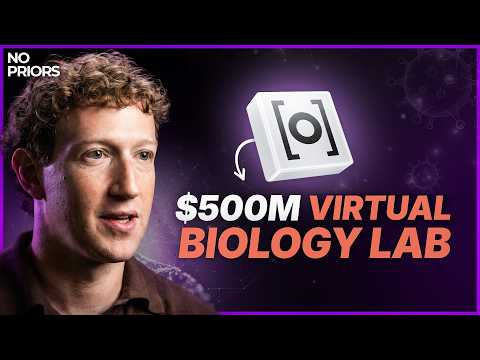
“Curing All Disease by next century is too conservative" - Mark Zuckerberg
The Brief
Open, wet-lab–coupled AI aims to industrialize protein design; data, not compute, is the moat.
Decision relevance
Read this for workflow impact, implementation trade-offs, and the claims that need technical scrutiny before they reach team planning.
Summary
What changed: Chan Zuckerberg Biohub is operationalizing a dual strategy—frontier AI tightly coupled with frontier biology—to build hierarchical “world models” from proteins to cells to systems. They released an open ESM Fold update claiming state-of-the-art structure and interaction prediction, plus emergent protein and antibody design, validated with limited wet-lab experiments. Crucially, they’re funding bespoke data generation (imaging, cellular engineering, biosensors) because internet-scale biological data doesn’t exist.
Why it matters: If true at scale, the pattern is a new R&D workflow: design in silico, digitally triage thousands of candidates, then validate in minimal wet-lab passes (e.g., 96-well), closing the loop to improve models. This shifts the competitive edge from raw GPU spend to high-quality, novel measurement pipelines and the ability to run fast AI↔lab iterations.
Who is affected: AI platform teams in bio, R&D orgs exploring AI for physical systems, and infra leaders deciding where to invest in data, lab automation, and safety governance. Open release means startups and academics can ride these tools; incumbents will need differentiated data/assays to avoid commoditization.
Tradeoffs and caveats: The “cure all disease this century is conservative” line is hype. Translation remains gated by biology’s complexity and regulation; clinical proof and safety are the long poles. Evidence presented is promising but early-stage (nanomolar binders in limited targets). Open-sourcing models that can design binders raises biosafety governance and misuse risks; Biohub acknowledges this but offers few concrete controls.
What teams should watch: 1) Closed-loop agentic workflows integrating ESM-like models with automated design–simulate–select–test cycles. 2) Emergent design quality on hard targets (membrane proteins, multi-specifics) and off-target prediction fidelity using single-cell atlases. 3) Infra patterns for coupling compute, LIMS, and lab robotics. 4) Whether hierarchical modeling scales beyond proteins to cell behavior where data is sparse and noisy. 5) How open tools alter IP strategy and whether safety norms emerge for release/usage.
Why It Matters
Biology-AI advantage will come from unique measurements and tight AI–wet-lab loops, not larger generic models.
Editorial analysis
Key claims
- Without novel data plus lab loops, your biology-AI roadmap will lag.
Practical use cases
- Use this as input for tooling evaluation, workflow planning, and technical due diligence.
Risks / caveats
- Century-scale cure timelines and imminent clinical translation rhetoric.
Who should care
- Engineering managers, tech leads, and CTOs evaluating AI or developer tooling decisions.
Related topics
Bottom Line
Without novel data plus lab loops, your biology-AI roadmap will lag.
Watch
This video is blocked due to your privacy settings. To watch this video, please accept YouTube marketing cookies.
Related breakdowns
Claude Fable 5 & Apple’s NVIDIA deal
A short briefing on the practical engineering implications, trade-offs, and claims worth ignoring.
Yossi Matias on the golden age of research
A short briefing on the practical engineering implications, trade-offs, and claims worth ignoring.
The CEO Must Be the Chief AI Officer
A short briefing on the practical engineering implications, trade-offs, and claims worth ignoring.
Get TL;DW
Too Long; Didn't Watch.
A concise breakdowns of the AI and devtools videos that actually matter for engineering leaders.
Free. Weekly. No hype.
Video and thumbnails remain the property of their respective creators. tldw.news provides editorial analysis, commentary, and discovery links to original content.