
Engineering brief
How to build proactive agents & self-improving company (Fully explained)
The Brief
Practical guide to building self-improving AI agent loops that handle long-running business ops (SEO, ads) with memory and feedback.
Decision relevance
Read this for workflow impact, implementation trade-offs, and the claims that need technical scrutiny before they reach team planning.
Summary
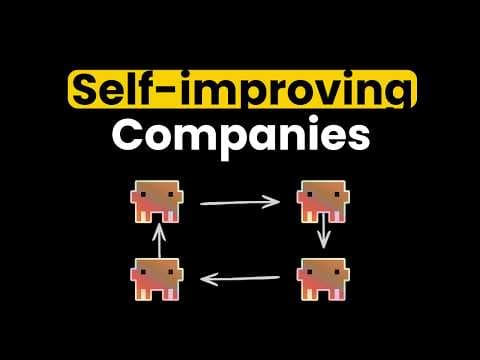
The real signal here is the shift from single-turn AI tasks to persistent, closed-loop agents that embed memory and feedback into daily operations. Instead of humans acting as the glue between tools, the architecture described uses chron jobs, temporal logs, and evolving skill files to let agents plan, execute, monitor results, and refine their own strategy over days or weeks. The SEO and ad-buying examples are concrete: an agent tests ugly whiteboard ad formats, learns they outperform slick designs, and autonomously shifts budget and creative. That kind of adaptive reasoning, captured in a simple state folder and procedural memory, is the core mechanic. The video unpacks a stack of practical components—memory layers (like the open-source JBrain or the team’s own ‘Loopony’), chron jobs for recursive execution and weekly planning, and agent-native skill wrappers (like Printing Press) that solve the common problem of CLIs being hostile to autonomous agents. These pieces aren’t magic; they’re tactical answers to the question, “How do we stop babysitting our automations?” The Y Combinator framing—companies hitting 5x revenue per employee—is provocative but thinly sourced; treat it as directional ambition, not a benchmark you’ll hit next quarter. The sponsorship segment is pure fluff, but the open-source links and the step-by-step memory-setup pattern give teams something they can copy and adapt this week. The real limitation is that the examples are all marketing-operation loops (SEO, ads, social posting); the pattern likely breaks down when you hit tasks with high regulatory risk, complex multi-stakeholder approvals, or sparse feedback signals. Also, watch out for the maintenance tax: these loops need human review of agent-proposed skill updates, or they can degrade quietly. Still, the video does the useful work of collapsing “self-improving company” rhetoric into a repeatable, files-and-cron design pattern that any team with basic API access can experiment with.
Why It Matters
Moves AI from one-off chat prompts to persistent, self-correcting workflows that compound improvements without constant human glue work.
Editorial analysis
Key claims
- A repeatable loop design with memory, cron, and skills files that lets agents improve over time—works for marketing ops now.
Practical use cases
- Use this as input for tooling evaluation, workflow planning, and technical due diligence.
Risks / caveats
- The YC 5x revenue stat is unverifiable; treat as narrative fuel, not a forecast for your team.
Who should care
- Engineering managers, tech leads, and CTOs evaluating AI or developer tooling decisions.
Related topics
Bottom Line
A repeatable loop design with memory, cron, and skills files that lets agents improve over time—works for marketing ops now.
Watch
This video is blocked due to your privacy settings. To watch this video, please accept YouTube marketing cookies.
Related breakdowns
Why Simpler AI Coding Workflows Win
Simplicity beats complex agent workflows: single-threaded tasks, minimal prompts, and context discipline produce faster, more reliable AI code.
Agent RL: Real Work, Real Infra, Custom Evals
Agent RL goes practical: smaller models, async training, custom evals. Benchmarks mislead — build for your domain.
Autonomous Coding Agents That Run for Hours, Not Minutes
LLM-judged goal loops reduce false completions in coding agents, but only if you define "done" with precision. Useful for overnight migrations, fragile for vague tasks.
Get TL;DW
Too Long; Didn't Watch.
A concise breakdowns of the AI and devtools videos that actually matter for engineering leaders.
Free. Weekly. No hype.
Video and thumbnails remain the property of their respective creators. tldw.news provides editorial analysis, commentary, and discovery links to original content.