
Engineering brief
How to Keep Shipping When You Walk Away from Your Desk — Zack Proser, WorkOS
The Brief
Blueprint for using coding agents without burnout: verification gates, signal layers, voice/remote control, and log-driven skill creation.
Decision relevance
Read this for workflow impact, implementation trade-offs, and the claims that need technical scrutiny before they reach team planning.
Summary
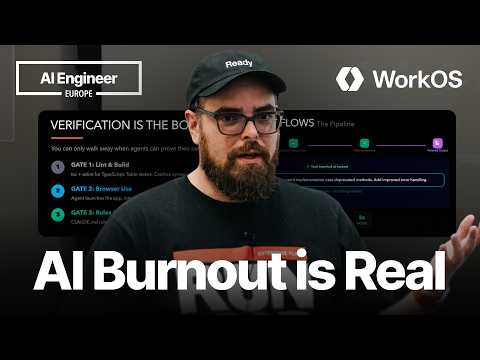
The talk reframes agent adoption: agents aren’t the bottleneck—human attention is. The proposed shift is from “chat with a copilot” to building an agent harness that self-verifies work, filters noise, and lets humans focus on judgment and review. Concretely: wire agents to your systems (Slack, Linear, browser) via MCP, specify verification criteria, and let agents loop until those checks pass, then confirm results in the environment they change.
A key workflow change is adding “signal layers” that triage inbound asks and deduplicate against tickets, so developers aren’t yanked into Slack every 10 minutes. Voice-first control speeds orchestration across multiple agent sessions, and “remote control” sessions (e.g., Claude Code) let leaders and seniors continue direction and review from a phone, keeping progress moving while away from the desk—useful for context-free planning and reducing physical strain.
For organizations, this argues for a Platform/DevEx-owned agent harness: integrations (Slack/Linear/Chrome), CI gates (lint, unit, e2e, browser clickthrough), per-task verification policies, and a process change—mark tickets “agent-ready,” queue them to run continuously (including overnight), and review diffs and logs in batches. Treat conversation logs (JSONL) as telemetry: run scheduled passes that surface recurring ambiguities and auto-generate/revise agent skills to reduce future churn.
Tradeoffs are real. Quality drift and hallucinations require strict gates, rollback paths, and audit trails. Remote control and broad tool access raise access, privacy, and data exfiltration risks; you’ll need secrets isolation, least-privilege scopes, and monitoring. Voice-first isn’t universally faster (environment, accents, security). Much of the evidence here is anecdotal; no hard benchmarks are provided, and “infinite scaling” is marketing gloss. Remote control is currently vendor-specific.
What to watch: set concurrency budgets per engineer to avoid cognitive overload; measure regression rate, PR review latency, MTTR for agent-introduced issues, and agent utilization versus human review time. The takeaway isn’t “run more agents,” it’s “architect for attention limits, automate verification, and continuously mine your own operations to teach the system new skills.”
Why It Matters
Agents aren’t the bottleneck—human attention is. Without guardrails, parallelism burns teams and breaks quality. Leaders must re-architect workflows and verification.
Editorial analysis
Key claims
- Design for attention constraints; automate verification; cap agent concurrency; ship while away without regressions.
Practical use cases
- Use this as input for tooling evaluation, workflow planning, and technical due diligence.
Risks / caveats
- Oura Ring anecdotes, shower-principle lore, and claims of infinite agent scaling.
Who should care
- Engineering managers, tech leads, and CTOs evaluating AI or developer tooling decisions.
Related topics
Bottom Line
Design for attention constraints; automate verification; cap agent concurrency; ship while away without regressions.
Watch
This video is blocked due to your privacy settings. To watch this video, please accept YouTube marketing cookies.
Related breakdowns
Why Can't Anyone Answer Questions About the Business? — Garrett Galow, WorkOS
A short briefing on the practical engineering implications, trade-offs, and claims worth ignoring.
PI AGENT FULL COURSE: Master Pi Agent in 30 Minutes
A short briefing on the practical engineering implications, trade-offs, and claims worth ignoring.
Shopify Staff Engineer: Why Your Multi-Agent AI Architecture Will Fail
A short briefing on the practical engineering implications, trade-offs, and claims worth ignoring.
Get TL;DW
Too Long; Didn't Watch.
A concise breakdowns of the AI and devtools videos that actually matter for engineering leaders.
Free. Weekly. No hype.
Video and thumbnails remain the property of their respective creators. tldw.news provides editorial analysis, commentary, and discovery links to original content.