
Engineering brief
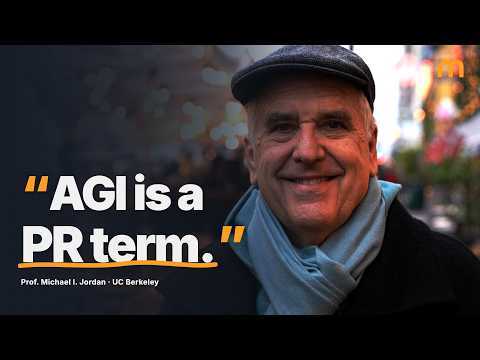
Intelligence is collective, not artificial — Prof. Michael I. Jordan (UC Berkeley / Inria)
The Brief
Build incentive-aligned AI systems; ignore AGI hype. Engineer markets, equilibria, and privacy-aware data flows around models.
Decision relevance
Read this for workflow impact, implementation trade-offs, and the claims that need technical scrutiny before they reach team planning.
Summary
Jordan’s core message: stop treating models as artificial minds and start engineering socio-technical systems. The work that matters now is microeconomics, incentives, and governance—how models, people, and organizations exchange data, value, and decisions at scale. AGI talk is a distraction; the meaningful frontier is mechanism design around ML components.
Practically, this means building systems around models, not inside them. Use models for prediction/optimization, then wrap them with: (a) error bars and cohort-style explanations users can act on, (b) small, targeted ground-truth collection to de-bias foundation model outputs (prediction-powered inference), and (c) incentive-compatible data contracts so producers are paid and data quality is rewarded. He highlights a concrete “three-layer data market” (users → platform → data buyers) where privacy budgets, payments, and data utility interact as a Stackelberg game—an equilibrium problem, not an optimization one.
Organizationally, this reframes AI programs: hire or partner with economists/market designers; add fixpoint/equilibrium analysis to the ML toolbox; budget for data acquisition and payments (not only GPUs); implement tunable privacy (e.g., differential privacy menus); and measure social welfare, regret, and equilibrium stability—not just model accuracy. Replace “AI as a personal assistant” with AI-augmented markets and workflows in regulated domains (finance, healthcare, supply chains), where human producers and consumers must be part of the loop.
Tradeoffs: equilibrium-centric design is harder, slower, and messier than shipping a chatbot. Privacy adds noise, reducing data buyer value; incentives reduce free data; small ground-truth studies cost time/money; and governance becomes first-class engineering. But these constraints are precisely how you achieve robustness, adoption, and regulatory fit.
Weak evidence/hype to discount: claims that multi-agent LLMs “discover” economics for free; anthropomorphic “understanding”; AGI timelines. What’s underweighted: aligning incentives yields larger system-level gains than chasing marginal model wins; explanation should be actionable (cohort-based), not mechanistic interpretability for its own sake.
Why It Matters
Leaders must architect AI as socio-technical markets—governed by incentives, privacy, and error bars—not as omniscient assistants.
Editorial analysis
Key claims
- Stop shipping chatbots; design incentive-compatible, privacy-priced, auditable AI systems that create value and jobs.
Practical use cases
- Use this as input for tooling evaluation, workflow planning, and technical due diligence.
Risks / caveats
- AGI timelines, “understanding” debates, anthropomorphic language, hand-wavy multi-agent emergent intelligence claims.
Who should care
- Engineering managers, tech leads, and CTOs evaluating AI or developer tooling decisions.
Related topics
Bottom Line
Stop shipping chatbots; design incentive-compatible, privacy-priced, auditable AI systems that create value and jobs.
Watch
This video is blocked due to your privacy settings. To watch this video, please accept YouTube marketing cookies.
Related breakdowns
Craig McLuckie on Culture as a Team's Operating System in the AI Era
A short briefing on the practical engineering implications, trade-offs, and claims worth ignoring.
The Architect's Guide to the AI Era • Luca Mezzalira & Teena Idnani • GOTO 2026
A short briefing on the practical engineering implications, trade-offs, and claims worth ignoring.
AI Won't Replace Engineers, But It Will Compress Roles
Role compression, not replacement: AI collapses engineering, product, and data science into T-shaped generalists. Invest in orchestration tooling and deep specialization.
Get TL;DW
Too Long; Didn't Watch.
A concise breakdowns of the AI and devtools videos that actually matter for engineering leaders.
Free. Weekly. No hype.
Video and thumbnails remain the property of their respective creators. tldw.news provides editorial analysis, commentary, and discovery links to original content.