
Engineering brief
NVIDIA's CUDA Moat: Your AI Strategy's Hidden Dependency
The Brief
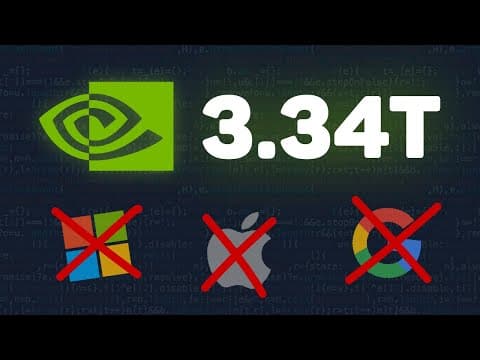
NVIDIA's $3.34T market cap reflects infrastructure lock-in, not just stock hype. CUDA's 2006 debut made it the default for AI training, creating a costly vendor dependency that shapes cloud budgets, hiring, and roadmap flexibility. Real risk: if your pipelines can't survive a shift to non-NVIDIA silicon, you have a bus-factor problem. Details inside.
Decision relevance
Read this for workflow impact, implementation trade-offs, and the claims that need technical scrutiny before they reach team planning.
Summary
NVIDIA's ascent to a $3.34 trillion market cap isn't just a stock story—it's a direct signal about where infrastructure power is concentrating in the AI ecosystem. The company didn't stumble into this dominance; it planted a strategic moat in 2006 with CUDA, a proprietary software layer that transformed graphics cards into general-purpose parallel computing engines. When deep learning exploded, CUDA was already the de facto standard, creating an ecosystem lock-in that's now incredibly expensive for teams to escape.
For engineering leaders, the real takeaway isn't NVIDIA's share price. It's the brittle dependency most AI workflows now have on a single vendor's hardware and software stack. Training modern large language models effectively requires CUDA-compatible GPUs, which means your AI strategy is currently an NVIDIA strategy. This shapes cloud budgets, on-prem infrastructure decisions, and hiring requirements, as engineers with CUDA optimization skills command premiums.
The crypto boom gave NVIDIA a financial windfall, but the lasting impact is the massive manufacturing and R&D scale they built during that period. When crypto cooled, that capacity pivoted seamlessly to AI workloads. The warning here is about supply chain fragility—if demand spikes again or geopolitical factors strain chip manufacturing, project timelines will break.
There's already a counter-movement brewing. Competitors like AMD are pushing ROCm, and frameworks like PyTorch 2.0 are abstracting compute backends. For most teams, the practical move isn't to bet against NVIDIA but to ensure your model architecture and training pipelines aren't so deeply CUDA-coupled that a hardware shift becomes a rewrite. Ask your ML engineers: what happens to our training pipeline if we had to run on non-NVIDIA silicon tomorrow? If the answer is a long silence, you have a bus-factor problem.
The hype to ignore is any certainty about NVIDIA holding the top spot. The video itself admits nobody knows what comes next. What matters is treating GPU compute as a strategic procurement question, not a default assumption.
Why It Matters
Your AI infrastructure costs and hiring plans depend on a single vendor's CUDA lock-in, creating both efficiency and concentration risk.
Editorial analysis
Key claims
- CUDA lock-in means your AI roadmap is an NVIDIA roadmap—plan for that vendor dependency explicitly.
Practical use cases
- Use this as input for tooling evaluation, workflow planning, and technical due diligence.
Risks / caveats
- Stock price speculation. NVIDIA's market cap fluctuations don't affect your build vs. buy decisions.
Who should care
- Engineering managers, tech leads, and CTOs evaluating AI or developer tooling decisions.
Related topics
Bottom Line
CUDA lock-in means your AI roadmap is an NVIDIA roadmap—plan for that vendor dependency explicitly.
Watch
This video is blocked due to your privacy settings. To watch this video, please accept YouTube marketing cookies.
Related breakdowns
5 Papers That Show Where AI Research Is Heading Right Now
A short briefing on the practical engineering implications, trade-offs, and claims worth ignoring.
The CEO Must Be the Chief AI Officer
A short briefing on the practical engineering implications, trade-offs, and claims worth ignoring.
How to operationalize AI governance with W&B Weave
A short briefing on the practical engineering implications, trade-offs, and claims worth ignoring.
Get TL;DW
Too Long; Didn't Watch.
A concise breakdowns of the AI and devtools videos that actually matter for engineering leaders.
Free. Weekly. No hype.
Video and thumbnails remain the property of their respective creators. tldw.news provides editorial analysis, commentary, and discovery links to original content.