
Engineering brief
Ring Cameras Become an Event-Driven Platform
The Brief
Ring is opening its cameras as an app platform via webhook-based event subscriptions, inverting the typical video ingestion pattern. Instead of polling feeds, your backend receives structured push events for motion, vehicles, or packages. This eliminates the hardest part of physical-world integrations: 24/7 video processing. For teams building reactive safety or analytics, the architecture shifts to a pure event handler. Worth reading for the operational trade-offs around webhook signature verification, clip expiration, and per-camera calibration that the demo glosses over.
Decision relevance
Read this for workflow impact, implementation trade-offs, and the claims that need technical scrutiny before they reach team planning.
Summary
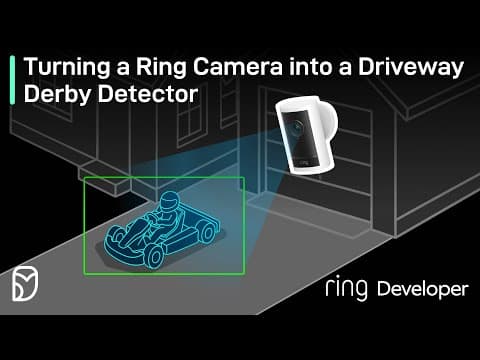
This demo reveals a potentially significant architectural shift for physical security: Ring is opening its cameras as an app platform via a partner API and webhook-based event subscription. The immediate technical takeaway isn’t the YOLO-based speed detection—it’s the inversion of control. Instead of your code polling a camera feed, the camera’s cloud service pushes structured events (motion, vehicle, package detection) to an endpoint you control. This lets a small backend respond to vehicle-detection events by downloading a short clip, running a lightweight model, and storing results for a dashboard—without ever managing a live video stream.
For teams building physical-world integrations, this pattern eliminates the hardest part: 24/7 video ingestion and on-device inference. The heavy lifting stays on Ring’s side. Your code becomes a pure event processor that can scale like any other webhook-driven service. The architecture shown is deliberately simple (single webhook handler, background job queue, a calibration constant mapping pixels to meters), but the implications are broader. Think: triggering Slack alerts for a speeding forklift, logging retail footfall to a data warehouse, or integrating with access-control systems when a recognized vehicle arrives.
Practical concerns are glossed over but unavoidable: webhook signature verification is mentioned but not explored, event delivery latency isn’t measured, and the clip download introduces a race condition if your backend doesn’t fetch the temporary URL before it expires. The calibration step is also hand-waved—mapping pixels to meters requires careful per-camera setup that won’t trivially generalize across installations. And the demo runs a single camera; at fleet scale, managing webhook registration, camera configuration, and video clip expiration becomes an operational challenge. Despite these gaps, the core concept—a camera OS that external developers can build against—matters. It parallels the shift from closed DVR systems to programmable sensor networks, and Ring’s consumer footprint gives it a distribution channel worth watching.
Why It Matters
Programmable computer vision cameras shift physical-security logic from closed hardware to composable software architectures.
Editorial analysis
Key claims
- Ring’s app store makes cameras event-driven platforms, letting teams build reactive safety and analytics with minimal stream processing.
Practical use cases
- Use this as input for tooling evaluation, workflow planning, and technical due diligence.
Risks / caveats
- The toy-car speed detection storyline is a demo veil; the real product is the webhook API.
Who should care
- Engineering managers, tech leads, and CTOs evaluating AI or developer tooling decisions.
Related topics
Bottom Line
Ring’s app store makes cameras event-driven platforms, letting teams build reactive safety and analytics with minimal stream processing.
Watch
This video is blocked due to your privacy settings. To watch this video, please accept YouTube marketing cookies.
Related breakdowns
How to Run LLMs Locally (Great For Learning and Privacy)
A short briefing on the practical engineering implications, trade-offs, and claims worth ignoring.
Cloudflare bought Vite to destroy Vercel
A short briefing on the practical engineering implications, trade-offs, and claims worth ignoring.
Build a Full-Stack GenAI Project in 4 Hours (FastAPI, React, Supabase)
A short briefing on the practical engineering implications, trade-offs, and claims worth ignoring.
Get TL;DW
Too Long; Didn't Watch.
A concise breakdowns of the AI and devtools videos that actually matter for engineering leaders.
Free. Weekly. No hype.
Video and thumbnails remain the property of their respective creators. tldw.news provides editorial analysis, commentary, and discovery links to original content.