
Engineering brief
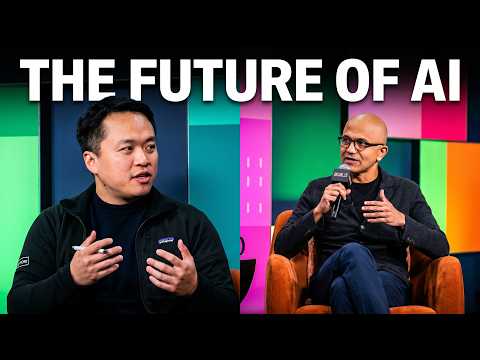
Satya Nadella on AI: @NoPriorsPodcast x Latent Space Crossover Special at Microsoft Build 2026
The Brief
Satya Nadella frames Build 2026 around platforms enabling every company to build its own frontier AI, not just consume one model.
Decision relevance
Read this for workflow impact, implementation trade-offs, and the claims that need technical scrutiny before they reach team planning.
Summary
Nadella’s core argument is that the current AI shift is an ecosystem play, not a single-model race. The measure of a platform is whether value created outside it exceeds value captured inside it. Microsoft’s goal, he says, is for every company—AI-native startup or traditional enterprise—to become a first-class participant that can point to AI it created. The stack matters: clean pre-training lineage, a multi-model harness, private evals, and hill-climbing scaffolds that let organizations switch models without losing performance. He admits the industry underestimated the real-world complexity of deploying models to deliver measurable value. Token maximization, he says, is an artifact of not tying tokens to value step-by-step.
The technical insight is that frontier performance can be achieved by collecting traces from a large model and then hill-climbing with a smaller reasoning model—something Microsoft demonstrated with Land O’Lakes. This shifts the definition of “operating at the frontier” from model size to the ability to compound on traces. Private eval emerges as the new IP moat: if you have an eval that lets you switch from Model A to Model B and still improve, you’re in control. If not, you’re dependent.
For engineering leaders, the operational implication is clear: the hard work is not picking a model but prepping the context layer, building the harness, and designing durable agent loops. Nadella points to GitHub Copilot’s new UI as proof that even successful coding agents have created excessive cognitive load on humans, forcing IDE rearchitecture. The same pattern applies to enterprise workflows—agents doing glue work overnight with delegated authority, then requiring new review surfaces.
On business models, he sees a mix persisting: per-user pricing (for budget certainty), consumption meters, and outcome-based pricing—though he notes customers love outcomes until they realize they’re sharing the upside. The SAS model isn’t ending but is being unbundled and rebundled. M365’s Work IQ demonstrates how company data previously captive to apps can become an agent-accessible database, creating new value layers. He cautions that agent euphoria will meet a budget-cycle reality check, forcing teams to decide what software to build vs. buy.
The societal angle is unusually frank for a CEO: Nadella openly discusses the need to earn community permission for data center buildout by showing tangible local benefits—grid improvements, water replenishment, jobs, tax base. He predicts the world will be skeptical of tech companies asking for trust without delivering visible outcomes first.
Why It Matters
The platform battle is shifting from which model wins to which harness lets organizations compound intelligence on their own data and private evals.
Editorial analysis
Key claims
- Private eval and multi-model harnesses are the real moat; pick infrastructure that lets you switch models without losing ground.
Practical use cases
- Use this as input for tooling evaluation, workflow planning, and technical due diligence.
Risks / caveats
- The "end of SAS" panic is premature; Nadella expects unbundling and rebundling, not extinction.
Who should care
- Engineering managers, tech leads, and CTOs evaluating AI or developer tooling decisions.
Related topics
Bottom Line
Private eval and multi-model harnesses are the real moat; pick infrastructure that lets you switch models without losing ground.
Watch
This video is blocked due to your privacy settings. To watch this video, please accept YouTube marketing cookies.
Related breakdowns
Claude Fable 5 & Apple’s NVIDIA deal
A short briefing on the practical engineering implications, trade-offs, and claims worth ignoring.
Yossi Matias on the golden age of research
A short briefing on the practical engineering implications, trade-offs, and claims worth ignoring.
The CEO Must Be the Chief AI Officer
A short briefing on the practical engineering implications, trade-offs, and claims worth ignoring.
Get TL;DW
Too Long; Didn't Watch.
A concise breakdowns of the AI and devtools videos that actually matter for engineering leaders.
Free. Weekly. No hype.
Video and thumbnails remain the property of their respective creators. tldw.news provides editorial analysis, commentary, and discovery links to original content.