
Agent autonomy segmentation is the new governance decision
Stack Overflow and Sam Newman both argue against one-size-fits-all agent governance.
Segment autonomy by risk, keep humans on architecture, and put a named person behind every agent output.
Autonomy by risk. Stack Overflow gives Codex tight constraints for enterprise work and free rein for experimental product.
Newman says keep humans on architecture and interfaces, let agents run inside well-bounded modules.
Both reject a single autonomy setting.
Segment agent work by risk and existing constraints.
Cost per task. OpenAI's applied team argues per-token prices mislead budgets.
Define a task, build an eval set, measure cost per completed task.
Prompt caching cuts costs by 90%.
Weights & Biases agrees: reward length penalty, not solve rate.
The metric shift is real but requires instrumentation work.
Codex value drop. OpenAI's $200 Codex plan once delivered $12,000 of monthly inference.
Changes cut that to roughly $2,000.
Claude's $200 plan still feels unlimited for production coding.
Treat Codex as a supplement for review and cheaper tasks.
The $500 ultrafast plan burns through limits in roughly two hours.
My take
I think the autonomy segmentation pattern is the day's most portable idea.
Too many teams argue over one AI policy instead of defining guardrails by risk tier.
On cost per task, OpenAI is right on principle but understates the engineering.
Building evals, instrumenting human fallback, and tuning caches is real work.
The 10x Codex cut is dramatic but the practical fix is boring.
Standardize on Claude for primary coding, use Codex for review, skip the $500 trap.
The fanboy wars distract from the simple governance and budgeting moves that actually scale.
The videos behind this brief
We watched these so you don't have to.
 Stack Overflow's Codex playbook: segment agent autonomy by riskOpenAI
 Sam Newman: Microservices are a last resort. Resilience is a people problem.The Pragmatic Engineer
 The Real AI Cost Lever Is Cost Per Task, Not Token PriceOpenAI
 Why your coding agent costs explode and how to fix itWeights & Biases
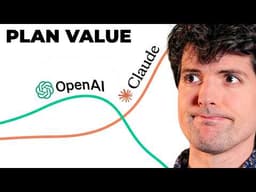 OpenAI's Codex plan lost 10x value. Claude is the better bet now.Theo - t3․gg
Video and thumbnails remain the property of their respective creators. tldw.news provides editorial analysis, commentary, and discovery links to original content.