
Topic
AI Infrastructure - Page 5
Model platforms, cost, latency, and operational trade-offs. Curated tldw.news briefings about ai infrastructure, with practical engineering takeaways from long-form AI and developer-tool videos.
237
breakdowns
Page 5 of 24
 Latent Space
Digital twins are 85% accurate—but only if you collect the right data
Simile AI achieves 85% accuracy in digital twin behavior prediction, outperforming frontier models by 2-3x on niche populations. The tradeoff: proprietary…
 AI Engineer
Agent building is easy. Context is where agents still fail.
Building agents is now trivial. But as Jeff Ng demonstrates, agents without organizational context confidently recommend fixes that caused past outages. The…
 Hugging Face
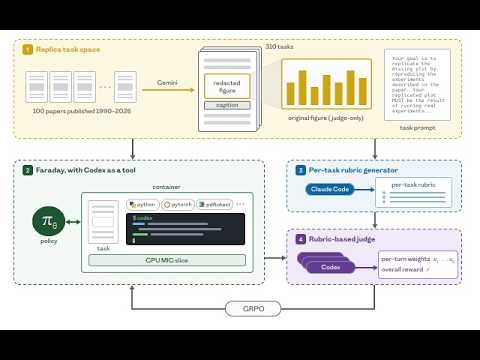
Smaller AI models can beat frontier models by using them as tools
A small RL-trained model outperforms frontier models at replicating ML research figures by using Codex as a tool—suggesting orchestration matters more than…
 IBM Technology
Stripe and IBM bet the model war is already over—routing is the
Stripe's $7B OpenRouter acquisition signals that routing, not models, is where AI value is moving. IBM's dual partnerships with OpenAI and Anthropic…
 Machine Learning Street Talk
Why the Silicon Valley singularity myth is a dangerous distraction
The singularity, Mars colonies, and AGI apocalypse are presented as a dangerous distraction. Learn why. A physicist dismantles tech's core growth assumptions.
 AI Engineer
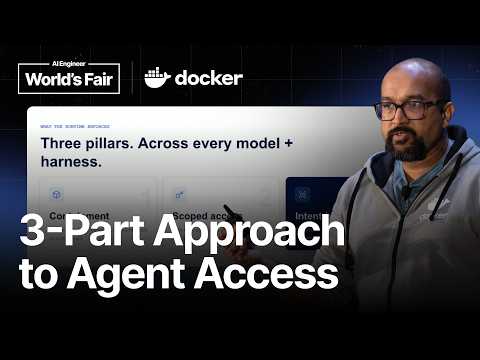
Agent safety moves from models to runtime-level governance
Agent intelligence is almost solved. The real challenge is safely granting dynamic, scoped access at runtime. Docker’s new runtime aims to provide that, but…
 AI Engineer
Your AI agents need an IT department. Here is the operating manual.
Agent safety is the next bottleneck. Decawork's CEO makes the case for treating AI agents as managed workers with identity, policy gates, and audit—not smart…
 NeuralNine
Local AI Just Got Real: 27B Model Rivals Big APIs for Half
A 27B open model now rivals frontier models on benchmarks, but its token waste and slow inference reveal the real tradeoff: ownership vs. speed in local AI.
 Y Combinator
White House AI strategy: open source, preemption, and the science ecosystem shift.
The White House AI strategy doubles down on open source and preemption, but the real signal is the shift in science funding and the push for autonomous labs.
 AWS Developers
Lambda MicroVMs: The snapshot trap every engineering leader needs to know
Lambda MicroVMs bring stateful, session-oriented compute to serverless. But the snapshot-based startup creates a hidden trap: randomness seeded at boot time…
Get TL;DW
Too Long; Didn't Watch.
A concise breakdowns of the AI and devtools videos that actually matter for engineering leaders.
Free. Weekly. No hype.