
Engineering brief
Agent Optimization Shifts From Models to Harness
The Brief
Harrison Chase's Interrupt talk splits agent archetypes into long-horizon and customer-experience—and argues the shared stack between them will shrink. The real signal: his team moved from top-30 to top-5 on Terminal Bench 2 by optimizing the harness alone, with zero model changes. The three-layer continual learning framework (model, harness, context) gives teams a systematic alternative to prompt-engineering churn. For eng leaders, this means agent improvement loops are becoming a platform and ops problem, not just a model selection one.
Decision relevance
Read this for workflow impact, implementation trade-offs, and the claims that need technical scrutiny before they reach team planning.
Summary
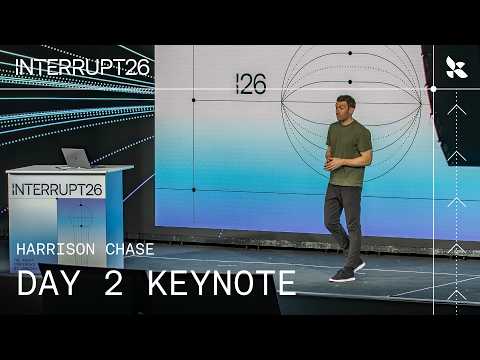
Harrison Chase's Interrupt 2027 vision splits the agent space into two divergent paths: long-horizon agents that run for hours or days executing code via sandboxes, and customer-experience agents where voice latency and brand control dominate. The real signal for engineering teams lies in his prediction that the shared stack between these archetypes will shrink over time, requiring teams to pick a lane and optimize their harness and context layers accordingly.
Chase leans heavily into three practical bets. First, voice pipelines are shifting from the brittle speech-to-text-to-speech sandwich toward native speech-to-speech models. He concedes these models are not steerable enough for production yet, but expects that to change within a year—teams building customer-facing agents should start prototyping now. Second, open models (specifically Qwen 3.5) are approaching frontier performance on agentic tasks while offering massive cost advantages for token-heavy coding agents. The Ramp and Prime Intellect fine-tuning example is concrete: low-latency, high-accuracy domain adaptation that proprietary models cannot match. Third, sandboxes for code execution become table stakes for any long-horizon agent, not just for software generation but for web browsing, data analysis, and deep research.
The most underreported takeaway is the three-layer continual learning framework: model, harness, and context. Chase draws a direct analogy to classical ML gradients, arguing that evals and traces function as the training signal for non-model layers. His team moved from top-30 to top-5 on Terminal Bench 2 purely by optimizing the harness, no model changes. LangChain Labs is the vehicle to productize this, using LangSmith traces as the foundation. For eng leaders, this signals that agent improvement loops are moving beyond prompt engineering into systematic optimization of the scaffolding code and runtime context.
Caroline di Vittorio's Fleet demo is a secondary data point: non-engineers at LangChain build and own agents end-to-end, with 84% weekly adoption by the go-to-market team and a claimed 240% lead-to-qualified conversion uplift. The underlying architecture—pre-built agents, tool integrations via Arcade's 7,500 tools plus MCP, Slack-native channels, and human-in-the-loop approval flows—reflects a pattern where domain experts become agent builders and engineering shifts to platform and governance work. This is not a future abstraction; it is their current operating model.
Why It Matters
The three-layer continual learning framework gives teams a concrete model for systematically improving agents beyond just swapping LLMs.
Editorial analysis
Key claims
- Agent improvement is moving from model-swapping to harness optimization. LangChain bets their platform on this shift.
Practical use cases
- Use this as input for tooling evaluation, workflow planning, and technical due diligence.
Risks / caveats
- Ignore the 2027 framing; the Fleet demo and continual learning signals are the real content.
Who should care
- Engineering managers, tech leads, and CTOs evaluating AI or developer tooling decisions.
Related topics
Bottom Line
Agent improvement is moving from model-swapping to harness optimization. LangChain bets their platform on this shift.
Watch
This video is blocked due to your privacy settings. To watch this video, please accept YouTube marketing cookies.
Related breakdowns
Graduated trust for autonomous patching
Three-agent architecture for autonomous patching with a graduated trust model. Sandboxed execution prevents destructive actions even if the LLM hallucinates. Practical blueprint for phasing AI into sensitive production systems.
Cloudflare bought Vite to destroy Vercel
A short briefing on the practical engineering implications, trade-offs, and claims worth ignoring.
Build a Full-Stack GenAI Project in 4 Hours (FastAPI, React, Supabase)
A short briefing on the practical engineering implications, trade-offs, and claims worth ignoring.
Get TL;DW
Too Long; Didn't Watch.
A concise breakdowns of the AI and devtools videos that actually matter for engineering leaders.
Free. Weekly. No hype.
Video and thumbnails remain the property of their respective creators. tldw.news provides editorial analysis, commentary, and discovery links to original content.