
Engineering brief
Graduated trust for autonomous patching
The Brief
Cogent's CTO lays out a concrete architecture for letting AI write patches in production—without giving it the keys to the kingdom. The key is a graduated trust model that starts read-only and only escalates to auto-remediation after staged validation. Interactive, background, and coding agents are separated for latency and safety, with sandboxed policy engines blocking destructive hallucinations. For CTOs, the real signal is how to make organizational context machine-readable without a graph database.
Decision relevance
Read this for workflow impact, implementation trade-offs, and the claims that need technical scrutiny before they reach team planning.
Summary
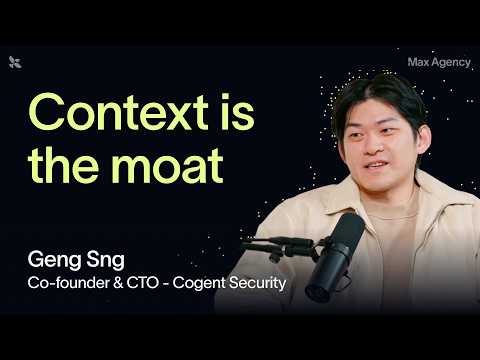
Geng Sng, CTO of Cogent, outlines a pragmatic architecture for autonomous cyber defense, moving past AI hype to address the real constraint: the collapse of mean-time-to-exploit from years to minutes. The core insight is that patching speed, not just detection, is the bottleneck. Their platform ingests massive, heterogeneous organizational data—ticketing systems, cloud assets, threat intel—to construct a high-throughput 'context graph' without using a traditional graph database, opting for a data lake architecture to handle billions of daily events.
The system separates concerns across three distinct agents: interactive agents for chat-based analyst queries, background agents for long-running data enrichment tasks, and internal coding agents for accelerating their own dev cycle. This architecture reflects practical engineering trade-offs. Interactive agents undergo a deeper planning phase (which paradoxically speeds up one-shot tasks) and have different latency requirements than background agents. For safety in a high-stakes domain, all customer-facing agents run in deeply permissioned sandboxes with a policy engine that prevents destructive actions even if the LLM hallucinates, a non-negotiable feature for enterprise trust.
Crucially, the path to autonomy isn't a switch but a gradient: customers start in read-only 'assisted' mode, then progress through auto-routing, auto-validation in staging, and finally auto-remediation for low-blast-radius assets. This graduated approach is designed to shrink the attack surface that can be autonomously fixed within minutes, while leaving zero-tolerance systems like payment processors under manual control. The variable challenge is not the patch itself, but predicting its 'production impact'—a task that cuts to the heart of team risk management.
The company differentiates between 'hot' (active, reusable) and 'cold' (archived) context, a more useful framework than short-term vs. long-term memory. Their eval system is multi-layered, using LLM-as-judge harnesses ranging from simple adversarial models to agents with full environmental parity to reproduce and assess a trajectory. For engineering leaders, this signals a future where AI is phased into sensitive production systems through evidence-based trust, not blind automation, with strong safety guardrails and a relentless focus on making organizational context machine-readable.
Why It Matters
Shows a practical blueprint for incrementally trusting AI with high-stakes write operations in production systems.
Editorial analysis
Key claims
- Defensive AI needs a graduated trust model and sandboxed execution, not just a convincing patch generation demo.
Practical use cases
- Use this as input for tooling evaluation, workflow planning, and technical due diligence.
Risks / caveats
- Generic talk on mean-time-to-exploit. Focus on the graduated trust and safety architecture.
Who should care
- Engineering managers, tech leads, and CTOs evaluating AI or developer tooling decisions.
Related topics
Bottom Line
Defensive AI needs a graduated trust model and sandboxed execution, not just a convincing patch generation demo.
Watch
This video is blocked due to your privacy settings. To watch this video, please accept YouTube marketing cookies.
Related breakdowns
Agent Optimization Shifts From Models to Harness
LangChain's continual learning framework: model, harness, context. A top-30 to top-5 benchmark jump from harness optimization alone. Agent improvement is becoming a platform engineering problem.
Cloudflare bought Vite to destroy Vercel
A short briefing on the practical engineering implications, trade-offs, and claims worth ignoring.
Build a Full-Stack GenAI Project in 4 Hours (FastAPI, React, Supabase)
A short briefing on the practical engineering implications, trade-offs, and claims worth ignoring.
Get TL;DW
Too Long; Didn't Watch.
A concise breakdowns of the AI and devtools videos that actually matter for engineering leaders.
Free. Weekly. No hype.
Video and thumbnails remain the property of their respective creators. tldw.news provides editorial analysis, commentary, and discovery links to original content.