
The Brief
CPUs prioritize flexibility, GPUs parallel throughput, and TPUs extreme specialization for tensor-heavy ML workloads; each involves trade-offs.
Decision relevance
Read this for workflow impact, implementation trade-offs, and the claims that need technical scrutiny before they reach team planning.
Summary
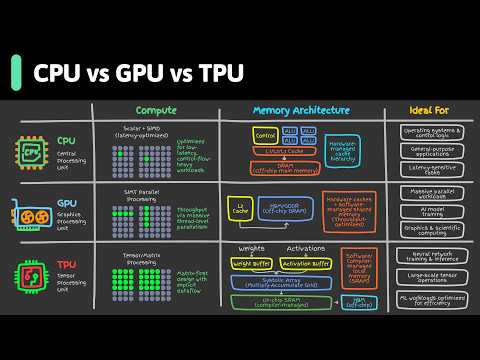
This video provides a clear, accessible breakdown of computational heterogeneity—a reality every engineering team shipping ML or data-intensive services eventually faces. The core signal is that there is no universal best chip, only an optimal match between workload shape and processor architecture. CPUs excel at sequential, branching tasks (control flow, orchestration, business logic) thanks to their low-latency, few-but-powerful cores. GPUs revolutionize high-throughput, data-parallel math (graphics, scientific computing, matrix multiplication) by packing thousands of simpler arithmetic units. TPUs push this specialization further, sacrificing almost all general-purpose flexibility to achieve extreme efficiency on tensor-heavy neural network operations, particularly large-scale model training and inference.
The practical implication for teams is about infrastructure cost and system design, not just speed. Running unsuitable workloads on the wrong chip wastes compute budget—a TPU idling during sparse control logic or a CPU attempting massive matrix multiplies both represent architectural misalignment. The video rightly frames specialization as a fundamental trade-off, avoiding the common hype that 'X chip is the future of everything.' It subtly highlights the rise of heterogeneous computing, where real-world systems lean on CPUs for orchestration, GPUs for general parallel acceleration, and TPUs or ASICs for tightly-defined, high-volume ML operations.
However, the piece stops short of explaining the engineering cost of this specialization: lock-in risks with proprietary TPUs (like Google's), software stack maturity differences, and the operational burden of managing multi-architecture pipelines. For managers, the key takeaway is less about technical detail and more about ensuring architecture decisions start with workload profiling, not hardware preference. The Snowflake sponsorship, while overt, doesn't undermine the core educational content, though it reinforces the video's broader audience: practitioners needing foundational infrastructure concepts.
Why It Matters
Workload-architecture mismatch wastes compute budget and constrains ML pipeline performance; chip choice is a direct cost and scalability lever.
Editorial analysis
Key claims
- Match workloads to chips: CPUs for logic, GPUs for parallel math, TPUs for tensor-heavy ML at scale.
Practical use cases
- Use this as input for tooling evaluation, workflow planning, and technical due diligence.
Risks / caveats
- The Snowflake sponsorship segment is unrelated to the processor architecture discussion.
Who should care
- Engineering managers, tech leads, and CTOs evaluating AI or developer tooling decisions.
Related topics
Bottom Line
Match workloads to chips: CPUs for logic, GPUs for parallel math, TPUs for tensor-heavy ML at scale.
Watch
This video is blocked due to your privacy settings. To watch this video, please accept YouTube marketing cookies.
Related breakdowns
How to Run LLMs Locally (Great For Learning and Privacy)
A short briefing on the practical engineering implications, trade-offs, and claims worth ignoring.
Cursor’s Founder on Why You Need Agent-First Infrastructure
Cursor's founder: train models on your toolchain, build your own sandbox orchestrator, and plan for agents that must prove their own output.
Ring Cameras Become an Event-Driven Platform
Ring cameras become programmable event sources. Push-based architecture eliminates 24/7 video ingestion. Practical for safety and analytics—if you handle webhook complexity.
Get TL;DW
Too Long; Didn't Watch.
A concise breakdowns of the AI and devtools videos that actually matter for engineering leaders.
Free. Weekly. No hype.
Video and thumbnails remain the property of their respective creators. tldw.news provides editorial analysis, commentary, and discovery links to original content.