
Engineering brief
I didn’t expect this from Anthropic
The Brief
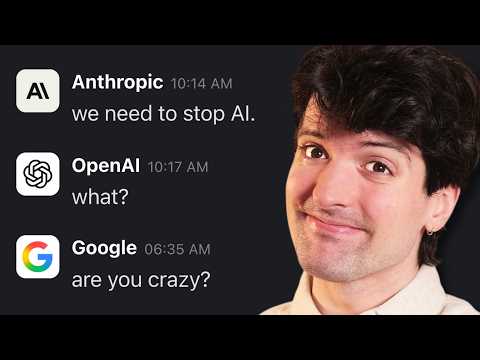
Anthropic shares internal data showing AI is dramatically accelerating their own AI research and code production, forcing hard questions about recursive self-improvement.
Decision relevance
Read this for workflow impact, implementation trade-offs, and the claims that need technical scrutiny before they reach team planning.
Summary
Anthropic's article, dissected here, moves past abstract AI safety debates by publishing internal metrics on how AI is compressing their own development cycle. The core signal isn't the headline-grabbing '8x code increase,' which they admit is a flawed vanity metric inflated by AI-generated lines. The real story is the shift in task complexity: their models now handle multi-hour, open-ended engineering tasks (like debugging a live training crash from a vague prompt) with a 76% success rate, up 50 points in six months. This represents a move from AI as a syntax copilot to AI as an autonomous junior engineer for narrow, well-defined goals.
The organizational bottleneck is visibly shifting from code creation to code review and research taste. When a single engineer can direct an agent to produce four years of human bug fixes in a short period, the traditional model of sprint planning and task decomposition breaks. The article inadvertently highlights this with a reported decline in the model's ability to handle trivial tasks while its complex reasoning improves. This maps to a future where senior staff become pure system supervisors, a workflow most engineering orgs are not designed for.
The article's most significant section details the automation of 'perspiration'—the grunt work of science and engineering—while acknowledging that 'inspiration' (goal-setting, judgment) remains the human domain, for now. Their internal experiment with agents conducting end-to-end alignment research is noteworthy not for the result (97% gap recovery), but because it proves the concept of parallelized, AI-driven experimentation. This implies research velocity is no longer limited by headcount, but by compute budget and the speed of human decision-making on which experiment to run next.
Anthropic's proposed scenarios—stalling, compounding efficiency, or recursive self-improvement—frame a strategic dilemma for leaders. The call for a global pause, issued alongside a trillion-dollar valuation, is dripping with strategic tension. They effectively argue 'we can't stop alone because others won't,' which is a pragmatic but self-serving position. The overlooked detail is their admission that a unilateral pause is 'achievable immediately' but they won't do it, framing the decision as an altruistic guard against less-cautious competitors rather than a standard market arms race.
The video host rightly flags the terrifying subtext from linked research: models can fine-tune other models using adversarial numeric sequences humans can't interpret. As AI begins to write the code and run the experiments for its own successor models, the principal-agent problem scales beyond human oversight. The real question isn't if AI can write code, but if we can validate the intent behind the code it writes for itself.
Why It Matters
Internal data proves AI is shifting from a coding tool to an autonomous engineering and research execution layer, redefining team structure.
Editorial analysis
Key claims
- AI progress is bottlenecked by human judgment and code review, not code generation. Structure teams for oversight, not output.
Practical use cases
- Use this as input for tooling evaluation, workflow planning, and technical due diligence.
Risks / caveats
- The 8x code volume metric; Anthropic admits 'lines of code' is a misleading productivity measure.
Who should care
- Engineering managers, tech leads, and CTOs evaluating AI or developer tooling decisions.
Related topics
Bottom Line
AI progress is bottlenecked by human judgment and code review, not code generation. Structure teams for oversight, not output.
Watch
This video is blocked due to your privacy settings. To watch this video, please accept YouTube marketing cookies.
Related breakdowns
The CEO Must Be the Chief AI Officer
A short briefing on the practical engineering implications, trade-offs, and claims worth ignoring.
How to operationalize AI governance with W&B Weave
A short briefing on the practical engineering implications, trade-offs, and claims worth ignoring.
LangChain's Bet: The Agent Control Plane
LangChain launches a unified agent lifecycle platform: build, test, deploy, monitor. Custom Rust database for traces, governance controls, and an AI co-pilot for debugging. The real signal is infrastructure standardization.
Get TL;DW
Too Long; Didn't Watch.
A concise breakdowns of the AI and devtools videos that actually matter for engineering leaders.
Free. Weekly. No hype.
Video and thumbnails remain the property of their respective creators. tldw.news provides editorial analysis, commentary, and discovery links to original content.