
Engineering brief
Route Planning to Opus, Code to Cheaper Models
The Brief
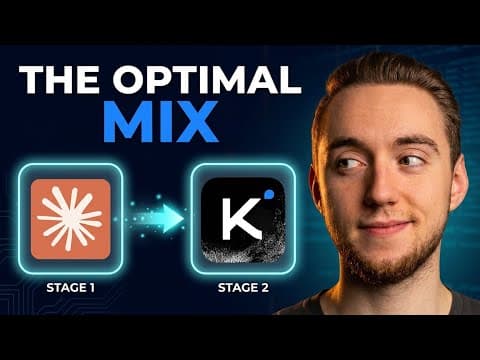
A live benchmark tested whether splitting AI coding workflow between an expensive reasoning model (Opus) for planning and a cheaper model (Kimi K2.6) for implementation can maintain quality while cutting costs. The evidence suggests yes—when the plan is hyper-specific, a weaker model executes surprisingly well. The counter-bet (strong model on code, weak on planning) didn't hold as cleanly. The real operational signal: frontier model access is becoming unreliable and expensive; intelligent token routing is shifting from optimization to necessity. Avoid the hype about any single model and focus on where you allocate reasoning budget in your pipeline.
Decision relevance
Read this for workflow impact, implementation trade-offs, and the claims that need technical scrutiny before they reach team planning.
Summary
This stream tests a hypothesis that matters for any team trying to balance AI code quality with runaway API costs: which part of a coding workflow benefits most from a strong reasoning model, and which parts can be offloaded to cheaper alternatives? The streamer built four Archon workflow variants (OO, OK, KO, KK) to isolate the effect of model choice at the planning stage versus the implementation stage, using three real GitHub issues of increasing difficulty. The core bet is that a top-tier model (Opus) writing a hyper-specific plan allows a weaker model (Kimi K2.6) to execute competently, achieving near-frontier results at a fraction of the token cost. The competing bet is that implementation is where models hallucinate dangerous code, so the strong model belongs at the code-writing step. The evaluation framework scores pull requests across seven dimensions, including root-cause soundness, surgical scope discipline, and fidelity to the original plan, providing structured evidence rather than hand-wavy comparisons. The stream also stumbles into a secondary insight: Google’s Gemini 3.5 Flash generates visually polished front-end code blisteringly fast but hallucinates architectural claims (e.g., inventing a Vercel AI SDK dependency). This reinforces the planner/implementer split idea for front-end work too—use a fast, design-fluent model for UI generation paired with a thorough model for content validation. Rate-limit degradation and subscription economics form the unspoken backdrop: frontier model access is becoming unreliable and expensive, making intelligent token routing an operational necessity rather than an optimization. The live format exposes real-world friction, including subprocess crashes, API failures, and retry logic, which is more honest than polished benchmark blog posts.
Why It Matters
Intelligent model routing can drastically cut AI coding costs without sacrificing quality, but only if you route the right model to the right step.
Editorial analysis
Key claims
- Splitting planning and implementation across different AI models can maintain quality while reducing reliance on expensive, rate-limited frontier models.
Practical use cases
- Use this as input for tooling evaluation, workflow planning, and technical due diligence.
Risks / caveats
- The specific Archon implementation details. The benchmark architecture matters more than the tool.
Who should care
- Engineering managers, tech leads, and CTOs evaluating AI or developer tooling decisions.
Related topics
Bottom Line
Splitting planning and implementation across different AI models can maintain quality while reducing reliance on expensive, rate-limited frontier models.
Watch
This video is blocked due to your privacy settings. To watch this video, please accept YouTube marketing cookies.
Related breakdowns
Cloudflare bought Vite to destroy Vercel
A short briefing on the practical engineering implications, trade-offs, and claims worth ignoring.
Build a Full-Stack GenAI Project in 4 Hours (FastAPI, React, Supabase)
A short briefing on the practical engineering implications, trade-offs, and claims worth ignoring.
Kubernetes and retiring at the top with Kelsey Hightower
A short briefing on the practical engineering implications, trade-offs, and claims worth ignoring.
Get TL;DW
Too Long; Didn't Watch.
A concise breakdowns of the AI and devtools videos that actually matter for engineering leaders.
Free. Weekly. No hype.
Video and thumbnails remain the property of their respective creators. tldw.news provides editorial analysis, commentary, and discovery links to original content.