
Engineering brief
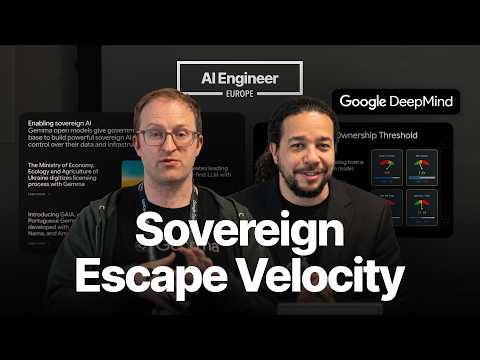
Sovereign Escape Velocity: Ownership w Open Models — Gus Martins, & Ian Ballantyne, Google DeepMind
The Brief
Gemma 4 makes open, Apache-licensed, on-prem and on-device AI viable for high-token, agentic workloads at lower TCO.
Decision relevance
Read this for workflow impact, implementation trade-offs, and the claims that need technical scrutiny before they reach team planning.
Summary
Google DeepMind positions Gemma 4 as the open counterpart to hosted Gemini: smaller, cheaper models you can actually own, run, and modify. The shift to Apache 2.0 removes a major legal blocker—procurement friction—from prior custom licensing. Practically, this makes Gemma deployable in regulated and sovereign contexts without months of legal review.
Technically, two things matter for operations. First, the 26B MoE (with ~4B active params) and the 31B dense model can run on a single modern GPU, changing the buy-vs-rent calculus for internal services and agent pipelines with heavy token throughput. Second, mobile-focused E2B/E4B variants squeeze multimodal inference onto phones by offloading non-transformer tables outside GPU memory. Net: meaningful on-device/autonomous capabilities without the cloud.
The promised win is price/performance for high-token workflows (programming, analysis, multi-step agents). Cost moves from API tokens to your energy and GPU utilization. That trade introduces new responsibilities: capacity planning, uptime, driver/runtime drift, latency SLOs, and heterogeneous device support (RAM, NPUs) if you go on-device. You also inherit eval and routing: when to use Gemini vs Gemma, and how to enforce guardrails/data locality.
Claims of “top leaderboard ELO” and “disproportionate intelligence per parameter” are marketing-adjacent; Arena ELO is preference-based, not task-SLO proof. Fine-tuning returns may be thin for languages because the base is already strong—expect diminishing gains and prioritize prompt/routing/adapters before full fine-tunes.
What most teams will miss: the economics flip for agentic systems. If your workload is high-token and predictable, owning inference likely cuts costs while improving data control, but only if you’re ready to operate model serving as a first-class service with proper observability, AB-routed evals, and hardware lifecycle plans.
Why It Matters
Apache-licensed, strong mid-size models enable sovereign, cost-controlled AI for high-token agents without sending data or spend to external APIs.
Editorial analysis
Key claims
- Hybrid stack: hosted Gemini for peak tasks, Gemma 4 locally for high-throughput, sensitive, or offline workloads.
Practical use cases
- Use this as input for tooling evaluation, workflow planning, and technical due diligence.
Risks / caveats
- Leaderboard ELO bragging, sovereignty anecdotes, flashy demos, and blanket claims of “frontier-like” capability.
Who should care
- Engineering managers, tech leads, and CTOs evaluating AI or developer tooling decisions.
Related topics
Bottom Line
Hybrid stack: hosted Gemini for peak tasks, Gemma 4 locally for high-throughput, sensitive, or offline workloads.
Watch
This video is blocked due to your privacy settings. To watch this video, please accept YouTube marketing cookies.
Related breakdowns
Stop Making Models Bigger, Make Them Behave — Kobie Crawdord, Snorkel
A short briefing on the practical engineering implications, trade-offs, and claims worth ignoring.
Build a Voice Agent in an Hour with Claude Code | AssemblyAI Workshop
A short briefing on the practical engineering implications, trade-offs, and claims worth ignoring.
May 2026 Recap
A short briefing on the practical engineering implications, trade-offs, and claims worth ignoring.
Get TL;DW
Too Long; Didn't Watch.
A concise breakdowns of the AI and devtools videos that actually matter for engineering leaders.
Free. Weekly. No hype.
Video and thumbnails remain the property of their respective creators. tldw.news provides editorial analysis, commentary, and discovery links to original content.