
Engineering brief
Surviving Anthropic Rate Limits via Model Orchestration
The Brief
Anthropic's degraded rate limits are forcing practical architectural shifts for AI coding pipelines. One approach: route planning to Opus and implementation to Kimi. The trade-off is brittle multi-model orchestration—no clean unified interface exists. Worth a look if your team is hitting API constraints on agentic workflows.
Decision relevance
Read this for workflow impact, implementation trade-offs, and the claims that need technical scrutiny before they reach team planning.
Summary
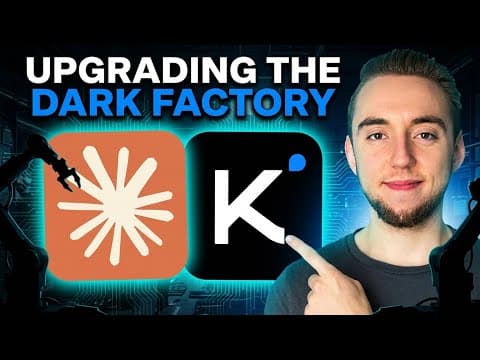
Cole Medin is tackling a very specific and timely pain point for teams pushing AI coding agents to their limits: Anthropic's degraded rate limits. His 'Dark Factory' experiment—a codebase that evolves itself from GitHub issue to deployed PR without human review—is a high-token consumer, making it the perfect testbed for a pragmatic workaround. He explicitly acknowledges that full autonomy isn't production-ready, but uses it to stress-test model orchestration.
The core engineering decision today is splitting the workflow by intelligence tier, not just random task. He's shifting the architecture of his Archon workflows (YAML-based agentic pipelines) to use Claude Opus strictly for the 'planning' node and Kimi K2.6 as the workhorse for everything else (research, implementation, validation). This directly addresses the cost and availability constraints engineering leaders are facing: the most powerful models are heavily rate-limited on subscription plans. The debate he highlights is genuinely practical—is superior reasoning more valuable during the specification/planning phase, or when rubber meets the road in code generation? He leans toward planning, arguing a perfect spec reduces downstream rework.
The implementation detail that matters is the painful provider switching. He can’t just use the Anthropic SDK globally and route it to different endpoints; mixing Opus and Kimi requires abandoning the Claude SDK 'hijack' that was routing everything to Kimi, and instead using a separate open-source agent ('Pi') to call Kimi's API, while simultaneously re-authenticating the native Claude toolchain against a real Anthropic subscription. This exposes the brittle state of current multi-model orchestration—there’s no clean unified interface.
He also confirms the adversarial validation pattern is critical without human review: a second agent reviews the PR with zero context of the implementation conversation, seeing only the issue and the final diff. This 'separation of concerns' for AI reviewers prevents bias creeping in from the builder agent’s thought process. The stream is a live look at the messy reality of stitching together subscription APIs, managing tokens, and building fault tolerance into autonomous pipelines, not a polished product demo.
Why It Matters
Anthropic rate limits are forcing real architectural shifts in CI/CD agents. Mixing providers by task intelligence is a practical, immediate solution.
Editorial analysis
Key claims
- Mixing Opus for planning with cheaper models for implementation is a viable pattern to survive current model rate limits.
Practical use cases
- Use this as input for tooling evaluation, workflow planning, and technical due diligence.
Risks / caveats
- Ignore the 'no human in the loop' framing. He admits it's highly experimental.
Who should care
- Engineering managers, tech leads, and CTOs evaluating AI or developer tooling decisions.
Related topics
Bottom Line
Mixing Opus for planning with cheaper models for implementation is a viable pattern to survive current model rate limits.
Watch
This video is blocked due to your privacy settings. To watch this video, please accept YouTube marketing cookies.
Related breakdowns
Systematically Improve Coding Agents Without Waiting for Model Upgrades
Stop treating agent failures as unsolvable. Automate feedback loops with rules and hooks today—but don't over-engineer. The principle: system evolution over model worship.
5 Papers That Show Where AI Research Is Heading Right Now
A short briefing on the practical engineering implications, trade-offs, and claims worth ignoring.
The CEO Must Be the Chief AI Officer
A short briefing on the practical engineering implications, trade-offs, and claims worth ignoring.
Get TL;DW
Too Long; Didn't Watch.
A concise breakdowns of the AI and devtools videos that actually matter for engineering leaders.
Free. Weekly. No hype.
Video and thumbnails remain the property of their respective creators. tldw.news provides editorial analysis, commentary, and discovery links to original content.