
Engineering brief
Systematically Improve Coding Agents Without Waiting for Model Upgrades
The Brief
The next step beyond context engineering: harness engineering aims to reduce agent failures by codifying rules, hooks, and orchestration. The real operational signal is the shift from waiting for better models to capturing every failure as a permanent improvement—pre-tool-use checks, validation hooks, and multi-session pipelines. But don't over-buy the buzzword; much of this is sound DevOps for LLMs. The question for your team: where does this guardrail investment pay off, and when does simpler manual hand-off suffice?
Decision relevance
Read this for workflow impact, implementation trade-offs, and the claims that need technical scrutiny before they reach team planning.
Summary
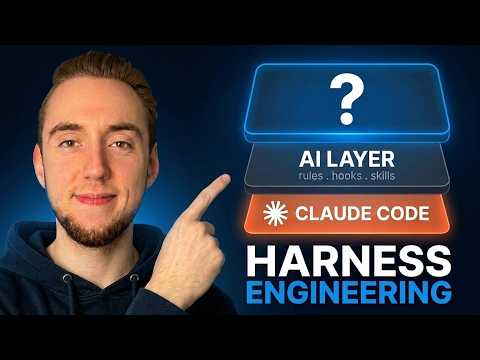
Harness engineering extends context engineering by adding control structures. While context engineering focuses on what you feed into a single session, harness engineering orchestrates multiple agent sessions, each narrowly focused, to prevent token overload and improve reliability. The core shift is a mindset: instead of waiting for model upgrades when the agent fails, you capture the failure as a new rule, hook, or skill. This turns every mistake into a permanent improvement to your AI layer.
The practical value is real. Teams already using tools like Claude Code or Cursor can start by codifying conventions in global rules, defining skills for common workflows (plan, implement, validate), and adding hooks for security and quality gates. Hook examples include pre-tool-use checks to block destructive commands and post-task validation hooks that force the agent to run tests and linting before considering work done. These aren't hypothetical—they're battle-tested patterns emerging across the industry.
But there's a hype tax. The term 'harness engineering' repackages solid software engineering practices (process definition, automated checks, modular task decomposition) with an AI label. The orchestration layer—what the video calls the 'peak evolution'—is essentially a pipeline where small agent tasks chain together via artifacts. The Ralph loop example is a simple while-loop script that keeps spawning coding agent sessions until a 'done' file appears. It works, but it's not novel; it's just devops for LLM-augmented coding.
Engineering leaders should evaluate how much of this is truly necessary for their teams. For small, focused tasks, manual session hand-offs with a clear plan-implement-validate cycle can suffice without complex orchestration. The real leverage comes from the feedback loops: hooks that catch errors early, rules that enforce conventions, and a documentation-first approach (agents.md) that aligns human and agent expectations. These reduce the chaos of undirected agent sessions and improve onboarding for new team members.
The video rightfully warns that dumping entire PRDs into a single session is a recipe for failure—models lose coherence beyond certain context lengths. However, the solution isn't always to build an elaborate harness; sometimes it's simply to refactor the task. Ultimately, harness engineering is about treating AI agents as brittle but trainable components that require guardrails and explicit process, just like any junior engineer. The tools and patterns will evolve, but the principle of system evolution over model worship is the lasting takeaway.
Why It Matters
Shifts responsibility from model vendors to engineering teams: you can systematically improve agent reliability today, without waiting for model upgrades.
Editorial analysis
Key claims
- Harness engineering is practical process design for coding agents—automate feedback loops and guardrails, but don’t over-engineer.
Practical use cases
- Use this as input for tooling evaluation, workflow planning, and technical due diligence.
Risks / caveats
- The 'harness engineering' buzzword and heavy self-promotion of tools.
Who should care
- Engineering managers, tech leads, and CTOs evaluating AI or developer tooling decisions.
Related topics
Bottom Line
Harness engineering is practical process design for coding agents—automate feedback loops and guardrails, but don’t over-engineer.
Watch
This video is blocked due to your privacy settings. To watch this video, please accept YouTube marketing cookies.
Related breakdowns
Autonomous Coding Agents That Run for Hours, Not Minutes
LLM-judged goal loops reduce false completions in coding agents, but only if you define "done" with precision. Useful for overnight migrations, fragile for vague tasks.
Surviving Anthropic Rate Limits via Model Orchestration
Practical pattern for bypassing Anthropic rate limits: split planning and implementation across models. Messy orchestration, but viable now.
I miss when programmers were lazy.
A short briefing on the practical engineering implications, trade-offs, and claims worth ignoring.
Get TL;DW
Too Long; Didn't Watch.
A concise breakdowns of the AI and devtools videos that actually matter for engineering leaders.
Free. Weekly. No hype.
Video and thumbnails remain the property of their respective creators. tldw.news provides editorial analysis, commentary, and discovery links to original content.