
Engineering brief
The AI Progress Chart Everyone Is Misreading — Beth Barnes & David Rein
The Brief
Meter’s Time Horizons is misread: it’s a directional capability trend, not job-parity. Scaffolding and task selection dominate outcomes.
Decision relevance
Read this for workflow impact, implementation trade-offs, and the claims that need technical scrutiny before they reach team planning.
Summary
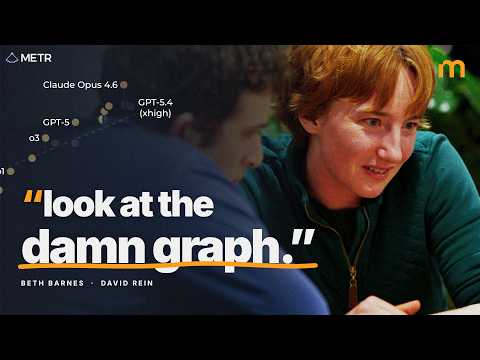
Meter reframes AI capability with a single axis: how long a task takes a competent human. They fit success rates vs human-time across diverse tasks in an agentic terminal harness to compare models from GPT‑2 to current SOTA. The curve looks logistic: models nail very short tasks and mostly fail longer ones. Crucially, they emphasize huge uncertainty: slope-regularization choices moved recent estimates ~35%, and real error bars are closer to 2x.
The biggest risk isn’t statistical noise; it’s distributional shift and task selection. Meter tries to avoid adversarial benchmarks that current models fail by design (which later regress-to-the-mean as labs train on them). They include weird, constrainted tasks to reduce regurgitation, but admit baselines are noisy (lognormal human times, varied expertise) and that any single “time horizon” number shouldn’t be conflated with real job performance.
On agent design, simple, general scaffolds often perform as well as fancy ones across varied tasks. Returns to inference compute are high; you may need hundreds to thousands of dollars of runs per model-task to know it truly plateaus. Small harness changes (e.g., making agents aware of token/time budgets) materially shift outcomes—raising credit-assignment and reproducibility issues.
Operationally, teams should not read “50% time horizon at 12 hours” as “12-hour jobs are done.” Models are more like week-one contractors: broad knowledge, little org context or tacit process. Reliability is mostly binary per task—either it always works or always fails—so production use needs task-level gating, strong success criteria, and escalation paths, not blanket autonomy.
What to watch: build an internal, workload-aligned eval suite with task durations, track binary success per task, measure sensitivity to scaffolding and compute budgets, and resist over-indexing on headline scores. Expect faster gains on short, well-bounded, toolable tasks; long, tacit, cross-system work remains brittle.
Why It Matters
Prevents miscalibrated roadmaps and staffing based on overinterpreted charts; guides how to deploy agents safely, reliably, and cost-effectively.
Editorial analysis
Key claims
- Use Time Horizons for direction, not parity. Invest in evals, scaffolds, reliability gates, and budget for inference compute.
Practical use cases
- Use this as input for tooling evaluation, workflow planning, and technical due diligence.
Risks / caveats
- Headlines claiming 12-hour tasks solved or imminent engineer replacement based on a 50% time-horizon number.
Who should care
- Engineering managers, tech leads, and CTOs evaluating AI or developer tooling decisions.
Related topics
Bottom Line
Use Time Horizons for direction, not parity. Invest in evals, scaffolds, reliability gates, and budget for inference compute.
Watch
This video is blocked due to your privacy settings. To watch this video, please accept YouTube marketing cookies.
Related breakdowns
When AI Discovers the Next Transformer — Robert Lange
A short briefing on the practical engineering implications, trade-offs, and claims worth ignoring.
Build a Voice Agent in an Hour with Claude Code | AssemblyAI Workshop
A short briefing on the practical engineering implications, trade-offs, and claims worth ignoring.
Stop Making Models Bigger, Make Them Behave — Kobie Crawdord, Snorkel
A short briefing on the practical engineering implications, trade-offs, and claims worth ignoring.
Get TL;DW
Too Long; Didn't Watch.
A concise breakdowns of the AI and devtools videos that actually matter for engineering leaders.
Free. Weekly. No hype.
Video and thumbnails remain the property of their respective creators. tldw.news provides editorial analysis, commentary, and discovery links to original content.