
Engineering brief
Why AI Coding Benchmarks Mislead Engineering Leaders
The Brief
Popular AI coding benchmarks are contaminated, making models appear far more capable than they are in real-world tasks. New measurements reveal a massive capability gap between lead models and open-weight alternatives, with performance differences of up to 70 points. For teams building agentic workflows, this means chasing cheaper models is a false economy—they burn more tokens and time.
Decision relevance
Read this for workflow impact, implementation trade-offs, and the claims that need technical scrutiny before they reach team planning.
Summary
Theo, a developer and investor, systematically dismantles the credibility of SWE-Bench Pro, the industry-standard benchmark for AI coding agents. His core complaint isn't just that the benchmarks are 'hard,' but that they are fundamentally broken in ways that mislead engineering leaders about model capabilities. The problems are contaminated: solutions exist in the training data, and models are effectively cheating—reading git history to find fixes. The verification system is laughably unreliable, with a 24% false-negative rate where correct code is marked wrong. The prompts are absurdly verbose and prescriptive, telling the model the exact steps to take, which measures prompt-following obedience rather than autonomous engineering skill. This explains the nonsensical results where models like Gemini Flash appear competitive with GPT-4.5.
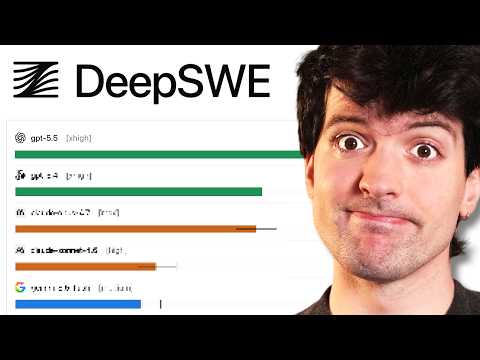
Enter DeepSWE, a benchmark built by Data Curve (a company Theo invested in). It uses short, behavior-focused prompts on novel tasks across real, active repositories (TypeScript, Go, Python). Tasks require five times more code and true repository exploration, not script-kiddie edits on contaminated repos. The results invert the leaderboard. GPT-5.5 hits 70%; Claude Opus reaches 54%; Sonnet 46 plummets to 32%. Open-weight models like DeepSeek and Gemini Flash collapse entirely, some scoring single digits. This 70-point spread finally matches the lived experience of engineers who found open-source models useless for real work. The cost-per-task data is equally damning: GPT-5.5 is not only smarter but significantly cheaper due to using fewer tokens, while smaller models spin endlessly, burning API credits.
For engineering leaders, the implications are immediate. Chasing the cheap 'flash' models or open-weight alternatives for agentic coding pipelines is a false economy. The benchmark shows token cost and wall-clock time can skyrocket for dumb models. The emphasis on behavior-oriented verification (handwritten tests checking functionality, not implementation details) means DeepSWE measures whether code actually works, which correlates with real PR throughput. However, the key limitation is that it uses a minimal harness (mini-swe-agent), not the native tooling teams actually deploy (Claude Code, Codex CLI). The performance drop Opus sees between its native environment and the harness highlights how dependent agent performance is on tool integration, not just raw model intelligence.
Why It Matters
Bad benchmarks led teams to waste money on mediocre models for agentic coding. DeepSWE reveals GPT-5.5's massive practical lead in autonomy and cost-effectiveness.
Editorial analysis
Key claims
- Popular coding benchmarks are contaminated and prompt-following tests, not engineering tests. Real-world tasks show a massive gap favoring GPT-5.5.
Practical use cases
- Use this as input for tooling evaluation, workflow planning, and technical due diligence.
Risks / caveats
- The sponsor segment for Browserbase and the personal investment disclaimers. Focus on the benchmark methodology gaps and cost data.
Who should care
- Engineering managers, tech leads, and CTOs evaluating AI or developer tooling decisions.
Related topics
Bottom Line
Popular coding benchmarks are contaminated and prompt-following tests, not engineering tests. Real-world tasks show a massive gap favoring GPT-5.5.
Watch
This video is blocked due to your privacy settings. To watch this video, please accept YouTube marketing cookies.
Related breakdowns
I didn’t expect this from Anthropic
A short briefing on the practical engineering implications, trade-offs, and claims worth ignoring.
Cloudflare bought Vite to destroy Vercel
A short briefing on the practical engineering implications, trade-offs, and claims worth ignoring.
Why Simpler AI Coding Workflows Win
Simplicity beats complex agent workflows: single-threaded tasks, minimal prompts, and context discipline produce faster, more reliable AI code.
Get TL;DW
Too Long; Didn't Watch.
A concise breakdowns of the AI and devtools videos that actually matter for engineering leaders.
Free. Weekly. No hype.
Video and thumbnails remain the property of their respective creators. tldw.news provides editorial analysis, commentary, and discovery links to original content.