
Context rot and security gates decide which agents ship
Long-running agents get worse as context fills, and teams only ship them when verification and isolation are treated as production work.
Budgets should move to validation, context curation, and tenant isolation before agents get credentials.
Verification gap. More AI code isn't more shipped software.
Sonar's CEO reports LOC up 2,450% and commits up 240%, but releases up only 30%; humans agreed with wrong AI four times out of five.
A production engineer warns you can't debug tests you didn't write.
Put eval sets and human review before every agent rollout.
Context rot. Reliability drops as the context window fills, and the fix is pruning rather than expanding.
Across 18 models, longer windows made agents worse, and the same task failed with 46 tools but passed with 19.
An agent's own stale note can become false truth, so budget context like memory and validate anything the agent persists.
Security floor. Multi-tenant AI infrastructure isn't safe by default, and agent data access is becoming a real cost center.
Audits of 80+ providers found broken tenant isolation, while OpenAI pulled 25% of production engineers into red-teaming.
Give each agent one identity, default-deny egress, and budget data access separately.
Weights & BiasesNo Priors: AI, Machine Learning, Tech, & StartupsAI Engineer
My take
Trust is the bottleneck, and trust is an engineering discipline built from context controls, verification, and isolation.
I agree with treating context and verification as first-class budget lines: that's where agents fail in production.
But I'd push back on the security-spending panic.
Many teams haven't done basic supply-chain audits or fixed known vulnerabilities.
Do the boring work first, and the agent strategy will follow.
That's the layer that decides whether any of this ships.
The videos behind this brief
We watched these so you don't have to.
 Agents hit finance: verification, security, and compute risk decide winnersAI Engineer
 If AI writes your tests, you can't debug the failuresHussein Nasser
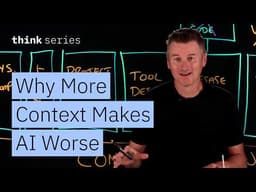 Context rot is real: your agent needs less context, not more.IBM Technology
 The next AI bottleneck is agent access to the web, not GPUWeights & Biases
 Security, not intelligence, becomes the new bottleneckNo Priors: AI, Machine Learning, Tech, & Startups
Video and thumbnails remain the property of their respective creators. tldw.news provides editorial analysis, commentary, and discovery links to original content.