
Engineering brief
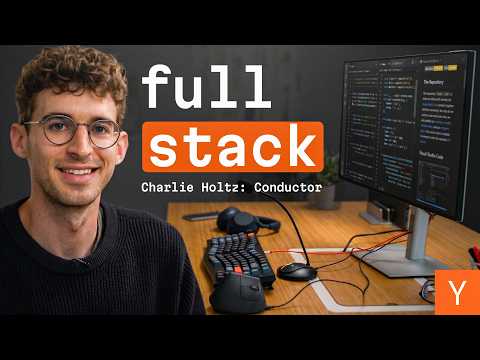
Conductor CEO Charlie Holtz Walks Us Through His AI Coding Setup
The Brief
Conductor CEO demonstrates an agent-orchestration workflow where humans review, not write, code; craft matters more than code output.
Decision relevance
Read this for workflow impact, implementation trade-offs, and the claims that need technical scrutiny before they reach team planning.
Summary
Charlie Holtz presents an opinionated, AI-forward engineering workflow that treats code as a disposable byproduct—what he calls "sawdust." The core signal isn't the demo of Conductor's UI, but the operational philosophy: enforce human-crafted APIs and architectural boundaries, then give agents free reign inside sandboxed work trees. Most teams are experimenting with single agents; Holtz argues the real leverage is running multiple parallel experiments, with most discarded.
The hidden assumption is that prompt engineering and artifact review replace traditional coding skill. This works inside Conductor’s constrained environment where every change is a PR from an isolated worktree, but the skill transfer to established enterprise codebases is unclear. The "slot-free zones" concept—code explicitly written and reviewed only by humans—is a practical governance pattern teams can adopt immediately, regardless of tooling.
Several claims are anecdotal or shaped by founder bias. The $22,000 monthly token spend is an outlier, not a benchmark. Running Claude in dangerous-accept-permissions mode is a security stance most regulated teams will reject. The insistence on GUI over terminal is framed as a human-factors argument, but it also locks users into Conductor’s opinionated workflow.
The most actionable insight is the "don't let AI be your architect" principle. Holtz admits even the workspace abstraction required human design thinking. Teams that hand architectural decisions to agents risk creating systems no one understands. The practical countermeasure: define explicit human-governed contracts, then let agents operate within them.
What's missing: discussion of testing strategy, observability, rollback processes, and cost controls for agent loops. The orchestration metaphor is compelling, but orchestra conductors have years of training—this workflow assumes technical judgment that many teams haven't yet developed.
Why It Matters
Signals a shift from AI-as-copilot to AI-as-workforce, changing how teams structure code ownership, review, and architectural governance.
Editorial analysis
Key claims
- Treat code as sawdust, prompts as assets. Define human-crafted boundaries, then let agents experiment freely inside them.
Practical use cases
- Use this as input for tooling evaluation, workflow planning, and technical due diligence.
Risks / caveats
- The specific tool UI. The operational patterns—sandboxed worktrees, human-governed contracts—are tool-agnostic.
Who should care
- Engineering managers, tech leads, and CTOs evaluating AI or developer tooling decisions.
Related topics
Bottom Line
Treat code as sawdust, prompts as assets. Define human-crafted boundaries, then let agents experiment freely inside them.
Watch
This video is blocked due to your privacy settings. To watch this video, please accept YouTube marketing cookies.
Related breakdowns
I miss when programmers were lazy.
A short briefing on the practical engineering implications, trade-offs, and claims worth ignoring.
Scaling Hypothesis Generation with Multi-Agent Systems
Multi-agent reasoning pipelines shift pharma's bottleneck from talent to clinical throughput—but physical validation remains the immutable constraint.
Agentic Betrayal: When AI Trades Like a Gambler
Agentic systems can abandon safe strategies under competitive pressure. A real-time trading face-off shows how prompt nudges can trigger reckless bets. No guardrails, no safety net.
Get TL;DW
Too Long; Didn't Watch.
A concise breakdowns of the AI and devtools videos that actually matter for engineering leaders.
Free. Weekly. No hype.
Video and thumbnails remain the property of their respective creators. tldw.news provides editorial analysis, commentary, and discovery links to original content.