
The Brief
The AI industry is hitting a multi-layer compute wall, and SpaceX/xAI is profiting from competitors’ capacity miscalculations.
Decision relevance
Read this for workflow impact, implementation trade-offs, and the claims that need technical scrutiny before they reach team planning.
Summary
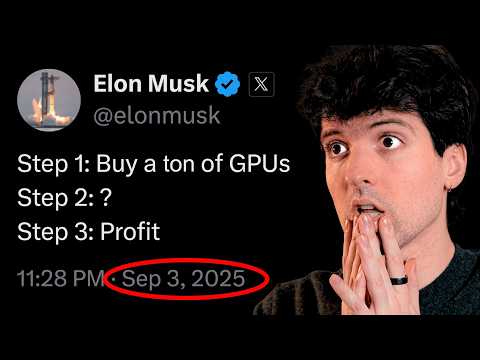
The video lays bare a structural compute crisis far deeper than temporary GPU shortages. TSMC’s fabrication capacity, high-bandwidth memory from a shrinking pool of manufacturers, hard drive supply, and power grid limitations form interdependent bottlenecks. Expanding any single layer takes 8–10 years, so even hyperscalers are stuck. Google, which builds its own TPUs, is now paying xAI $1B/month because it can’t meet internal demand. Anthropic, after conservatively avoiding overspend, is forced to rent from a competitor. Microsoft openly admits being capacity-constrained. This isn’t just about price—it’s about availability. The xAI windfall came from Elon’s aggressive compute bet: they overbought GPUs for Colossus, and now lease idle capacity at a rate that recoups their $3–4B investment in months. Simultaneously, consumer hardware—RAM, SSDs, hard drives—is getting sidelined as suppliers prioritize datacenter contracts. The implications for engineering leaders are stark. Cloud elasticity is an illusion; capacity can vanish. Architecture decisions may need to shift toward smaller, more efficient models or edge inference to reduce dependency. Budgeting must account for multi-year compute reservations, and power availability may dictate where workloads run. The winners will be those who treat compute supply as a strategic moat, not a utility. But the crisis also exposes fragility: if demand wavers, those holding large compute contracts could be left with stranded assets. The video’s core signal is not that AI progress will halt, but that the pace and economics of deployment are now dictated by physical manufacturing constraints, not software breakthroughs.
Why It Matters
Compute scarcity will define which teams can ship, how fast they iterate, and how budgets are allocated across projects.
Editorial analysis
Key claims
- Secure compute capacity now or risk being unable to deliver AI features at all.
Practical use cases
- Use this as input for tooling evaluation, workflow planning, and technical due diligence.
Risks / caveats
- Sponsor pitches and casual speculation about stock prices that aren't backed by data.
Who should care
- Engineering managers, tech leads, and CTOs evaluating AI or developer tooling decisions.
Related topics
Bottom Line
Secure compute capacity now or risk being unable to deliver AI features at all.
Watch
This video is blocked due to your privacy settings. To watch this video, please accept YouTube marketing cookies.
Related breakdowns
I didn’t expect this from Anthropic
A short briefing on the practical engineering implications, trade-offs, and claims worth ignoring.
Cloudflare bought Vite to destroy Vercel
A short briefing on the practical engineering implications, trade-offs, and claims worth ignoring.
Why AI Coding Benchmarks Mislead Engineering Leaders
Contaminated benchmarks mask a 70-point gap between top coding models. Real-world tasks reveal which models actually deliver.
Get TL;DW
Too Long; Didn't Watch.
A concise breakdowns of the AI and devtools videos that actually matter for engineering leaders.
Free. Weekly. No hype.
Video and thumbnails remain the property of their respective creators. tldw.news provides editorial analysis, commentary, and discovery links to original content.