
Engineering brief
Train AI Robots Without Writing Code! (Introducing LeLab)
The Brief
LeLab provides a no-code GUI to teleoperate, collect data, train, and deploy robotics policies via Hugging Face.
Decision relevance
Read this for workflow impact, implementation trade-offs, and the claims that need technical scrutiny before they reach team planning.
Summary
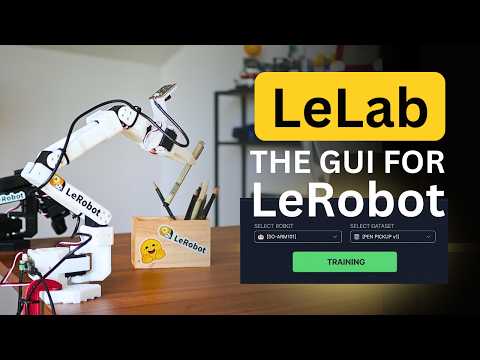
LeLab is a GUI wrapper for the open-source LeRobot library, designed to remove the coding barrier from imitation learning for robotics. The tool allows users to teleoperate a leader-follower robot arm setup, record episode-based datasets, and train policies either locally or via rented Hugging Face GPU instances. The interface handles robot calibration, camera configuration, dataset upload to the Hugging Face Hub, and model deployment.
The significant operational shift here is the full vertical integration of the ML pipeline—data collection, training, and deployment—into a single, non-code interface. For an engineering organization, this signals a potential shortening of the experimental loop in physical AI tasks. A lab technician or domain expert can now iterate on a physical task without an ML engineer in the loop after the initial hardware setup. The recording of 50 episodes in 15 minutes implies a data velocity that changes how quickly a team can test a hypothesis about task feasibility.
The tradeoffs are substantial. The demo shows a simple pick-and-place task with minimal variation. The claim that 50 smooth episodes produce a working policy is contingent on the task complexity and environment stochasticity. The reliance on Hugging Face's GPU infrastructure introduces a dependency on public cloud for training; teams in environments with network air gaps, strict data residency requirements, or proprietary hardware will find this workflow incomplete. The system's behavior under noisy, unstructured, or safety-critical conditions is not addressed.
The most under-discussed aspect is the data quality bottleneck. The interface shifts the burden from code to operator consistency. The video explicitly states that dataset quality is the critical factor, but provides no tooling for validating consistency across episodes beyond human review. For an engineering manager, this means a new process challenge: training operators to generate high-quality demonstrations becomes the equivalent of a code review process.
The tool lowers the floor for experimentation but does not yet signal a production-ready framework. Teams should treat this as a rapid prototyping accelerator while planning for the traditional ML infrastructure and reliability engineering that will be required for a production deployment.
Why It Matters
Collapses the robot ML pipeline into a no-code interface, changing who can experiment and how fast prototyping cycles run.
Editorial analysis
Key claims
- A rapid prototyping accelerator for imitation learning, not a shortcut to production-grade robotic systems.
Practical use cases
- Use this as input for tooling evaluation, workflow planning, and technical due diligence.
Risks / caveats
- Overestimating applicability to complex, safety-critical, or highly variable tasks without further evidence.
Who should care
- Engineering managers, tech leads, and CTOs evaluating AI or developer tooling decisions.
Related topics
Bottom Line
A rapid prototyping accelerator for imitation learning, not a shortcut to production-grade robotic systems.
Watch
This video is blocked due to your privacy settings. To watch this video, please accept YouTube marketing cookies.
Related breakdowns
Build a Voice Agent in an Hour with Claude Code | AssemblyAI Workshop
A short briefing on the practical engineering implications, trade-offs, and claims worth ignoring.
Stop Making Models Bigger, Make Them Behave — Kobie Crawdord, Snorkel
A short briefing on the practical engineering implications, trade-offs, and claims worth ignoring.
Sovereign Escape Velocity: Ownership w Open Models — Gus Martins, & Ian Ballantyne, Google DeepMind
A short briefing on the practical engineering implications, trade-offs, and claims worth ignoring.
Get TL;DW
Too Long; Didn't Watch.
A concise breakdowns of the AI and devtools videos that actually matter for engineering leaders.
Free. Weekly. No hype.
Video and thumbnails remain the property of their respective creators. tldw.news provides editorial analysis, commentary, and discovery links to original content.